Create a Dopamenu: Your Personal Reset Guide
Imagine you are in a meeting, and someone says something that lands wrong. Your mind starts to spin as you try to maintain your composure.
Or you are at your desk trying to focus, and a notification pops up. Suddenly, you're tense, and it feels like you can't make any decisions.
When something triggers you, your amygdala sounds the alarm before your thinking brain has a chance to weigh in. Cortisol spikes, your prefrontal cortex goes offline, and suddenly, you cannot access your own best thinking. Your brain is not trying to be difficult. It’s trying to keep you safe.
The goal is to interrupt the automatic response and return to a regulated state where you have a choice in your decision-making.
What’s A Dopamenu?
A Dopamenu is a personal guide for calming your nervous system, organized by how much time you have. Different challenges call for different actions, and it’s helpful to have multiple options ready before you need them. Below are the categories I like to use for my Dopamenu.
Palate Cleansers (30 seconds or less)
Many Dopamenus start with the appetizer, but I need a lot of ideas to help me quickly reset. Think of palate cleansers as pauses to create space for a better choice.
Press your feet flat on the floor, roll your shoulders, and/or close your eyes.
Look out a window or behind you.
Breathe in and out slowly a few times
Clench your fists for five seconds, then release
Appetizers (under five minutes)
Appetizers are things that you can do quickly to take a short break.
Stretch
Do a breathing exercise while taking a biobreak
Send a text or connect another way
Listen to or dance to one song that makes you smile.
Entrees (15 minutes or more)
Entrees are restorative. They are the things you do for a longer break so you can return refreshed.
Take a short walk
Do a series of exercises
Organize or cook something
Read
Sides (concurrent activities)
Sides are things you can add without interfering with what you are trying to accomplish.
Sip a hot beverage
Use a standing mat or fidget tool
Listen to background music
Burn a candle
Desserts (guilty pleasures)
It’s important to have and be intentional about our guilty pleasures. I include some of these as appetizers and others as rewards.
Social media with a timer
A favorite show or movie
Funny animal videos
A mobile game or a fun book
Specials (occasional treats)
It's also important to plan for special treats. Sometimes the planning or anticipation is as exciting as the event.
A massage
A weekend away or a longer trip
A concert

Build Your Menu
I find that thinking through different scenarios where I need ideas for managing my emotions helps me build my Dopamenu. I start by listing ideas and then think about what time frames they might fit into. Some things can fit into multiple time categories, like breathing. One can take a few breaths in 30 seconds, or do breathing exercises for 5 to 15 minutes, or more.
Reflect On:
What are ten things you can do in 30 seconds to 5 minutes when you are triggered and have very little time to recover?
What genuinely restores you, versus what do you reach for out of habit when you are alone and have time to recover?
How can you handle challenges when you are triggered in front of other people?
What activities can you do to prepare in advance for difficult situations?
Think of three moments when you felt safe and at ease. What was happening? Is there anything from those moments you could add to your Dopamenu?
As I continue to notice how I’m feeling in different situations, I’ve realized that when I’m happy and engaged, I feel safe. When I’m not emotionally regulated, I tend to feel agitated.
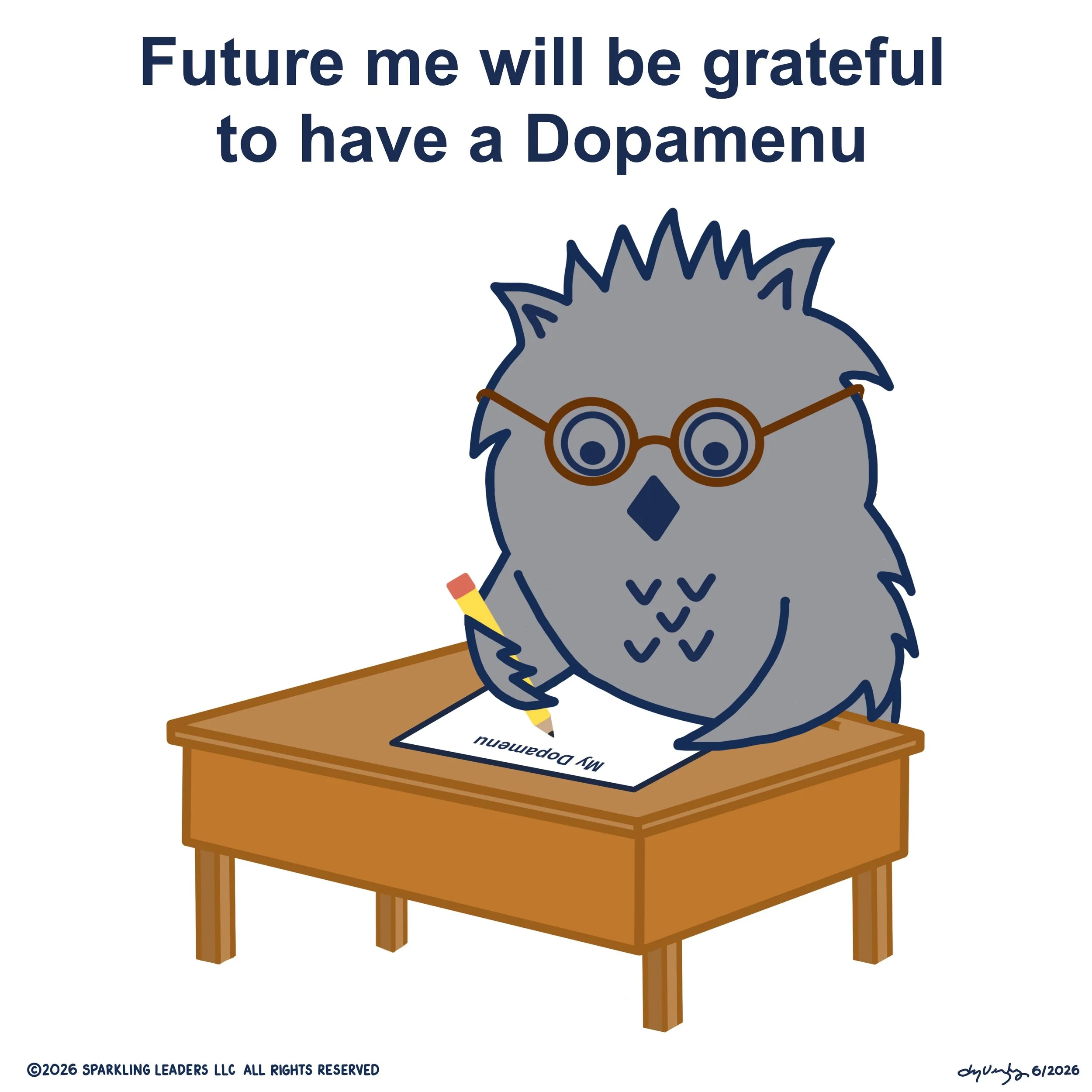
Take the information that you've gained from the questions above and start adding it to a menu. You can download a template here or from the image above.
Using Your Dopamenu
The next time something triggers you — a comment in a meeting, a notification on your screen — remember your Dopamenu and try one from your personal list of helpful actions.
What goes on your menu?